
The video is a bit smudged from our friend the badger, and on first glance a friend of mine thought they looked more like a New Zealand Kiwi. Kiwis they are not, or else I'd have every birder in Britain trying to find out where the trailcam is and trying to obtain the most tickable bird ever probably)..... but at least for the BCIB, we can now tick off partridge on our species list.
Charlie Bones (BCIB Sussex)

Friday, 24 September 2010


Wednesday, 15 September 2010
Bornean Clouded Leopard Programme, Leopard Cats and Flat Headed cats
One of joys of creating this blog, and using trigger cameras, is finding out about other organisations using the same methods, to capture images of their local wildlife. One research programme, I have been following from my armchair for the last few years is the Bornean Clouded Leopard Programme.
The Bornean Clouded leopard Programme, is a joint multi-site research collaborative effort between the Sabah Wildlife Department in Borneo and the Wildlife Conservation Research Unit (WildCRU), University of Oxford.
They aim to advance understanding and enhance the conservation of the Sunda clouded leopard and other threatened Bornean wild cats in Sabah. This is being done by short term camera trap surveys designed to estimate clouded leopard densities and felid community structure in six key forest areas within Sabah, Borneo. In addition, an intensive camera trap survey is being implemented for approximately 2.5 years at a single forest site, designed to provide insights into the ecology of the clouded leopard.
The project is being led by Andrew Hearn and Joanna Ross.
The Bornean Clouded leopard Programme, is a joint multi-site research collaborative effort between the Sabah Wildlife Department in Borneo and the Wildlife Conservation Research Unit (WildCRU), University of Oxford.
They aim to advance understanding and enhance the conservation of the Sunda clouded leopard and other threatened Bornean wild cats in Sabah. This is being done by short term camera trap surveys designed to estimate clouded leopard densities and felid community structure in six key forest areas within Sabah, Borneo. In addition, an intensive camera trap survey is being implemented for approximately 2.5 years at a single forest site, designed to provide insights into the ecology of the clouded leopard.
The project is being led by Andrew Hearn and Joanna Ross.
Andy and Jo during their last project in Borneo

Andy describes their trail cam methods as such,
We're using several models: Snapshot Snipers (which use a Sony P41/P43 camera), Cuddeback captures, and Bushnell Trophy Cams. We have bait in the past, food items such as shrimp paste etc, as well as trapping lures from the US, but these tended to attract non-target species (bearded pigs and civets mainly), or had no discernible effect on attracting Bornean felids (trapping lures). Having first determined that we could get some of the cats on the cameras we started using mark-recapture methods to estimate their density - and generally it is better not to use bait due to methodological issues.
When available, we place the cameras along existing human trails, the drier, longer and clearer the better. Abandoned old logging roads, again, ideally dry and not too degraded (i.e. still relatively clear of vegetation) are also preferred sites. Natural ridge lines, or other topographical features that may filter animal movements are also used - ridges in particular appeared to selectively utilised by a number of mammals. In the absence of such features, we create our own trails, clearing the vegetation and even sweeping the trail clear of leaf litter. Such trails are typically 4-500 m long, ideally longer, but logistics often mean that this is all we can realistically achieve given our timeframe. Again, many mammals start using the new trails, as can be witnessed by the cameras snapping them moving down the trail.
We typically have a minimum of 35 pairs of cameras running (currently 40 pairs), and we move these to a second survey area, resulting in a survey of a min of 70 sites per 130km2 study area.
Andy and Jo have kindly given us permission to reproduce some of the pictures of cats they have recently captured on camera. There are many more images on their blog site of other animals caputured on camera during their previous research project. It's a blog I would highly recommend to everyone with an interest in wild cats or wildlife in general, it is full of details of the project and its aims. I for one will certainly be following this blog with interest over the following year or so.
All these images are copyright of Andy Hearns and Jo Ross, and should be contacted via their blog if you wish to reproduce these images elsewhere. I have repoduced the comments from the team that accompanies each photograph from their blog.
Our first wild cat photo- capture - a flat-headed cat

A leopard cat. This adaptable species is thought to respond well to habitat disturbance, and unlike the other 4 Bornean felids can be found residing in oil palm plantations. It's a little surprising then, that this is our first photo of this species - but again it is early days.

Our second flat-headed cat photo. Frustratingly, the other camera failed to pick up the cat.

Tuesday, 14 September 2010
More images from the muntjac carcass site.
Tim Jenkins (BCIB Warwickshire), checked his muntjac carcass site yesterday and found some squirrel, deer and fox pictures as well as his first pictures of a badger. When Tim got there the cam had big muddy paw prints over it where the badger had investigated it VERY closely. This is the second badger in less than a week that has had a go at one of our cameras in locations hundreds of miles apart.


Monday, 13 September 2010
Hungry badger taste testing the camera.
I had a bit of a shock when I recently checked the trailcam. I check it every week, the batteries and memory can last at least a month but I look forward to viewing what pictures it's captured, I find it very exciting and captivating. Plus if anything has gone wrong, I can sort it out.
On checking the camera this time I found the camo net was torn and the lens was smudged. Although the angle was still roughly right it certainly wasn't how I left it.
The culprit, as I played back the 30 second film was plain to see. It was the badger who shows up from time to time. Still, no harm done as it seems this cam is bulletproof and hopefully it will leave it alone now it's had a taste. I've set it for the prime purpose of capturing a cat, so even the up close shots should fit the whole body in. Although the videos now will be a bit overexposed as it points more up to the sky......
Charlie Bones (BCIB Sussex)
On checking the camera this time I found the camo net was torn and the lens was smudged. Although the angle was still roughly right it certainly wasn't how I left it.
The culprit, as I played back the 30 second film was plain to see. It was the badger who shows up from time to time. Still, no harm done as it seems this cam is bulletproof and hopefully it will leave it alone now it's had a taste. I've set it for the prime purpose of capturing a cat, so even the up close shots should fit the whole body in. Although the videos now will be a bit overexposed as it points more up to the sky......
Charlie Bones (BCIB Sussex)
Wednesday, 8 September 2010
Badger, Fox and Roe Deer
Here are the latest batch of images from the same location as the unidentified large cat in Argyll. Along with tens of pictures of a fox, there was also one of the badger, that likes to make an appearance every now and then, (and I still can't find out where it is coming from as there is no sign of a badger sett anywhere nearby). Also a nice close up picture of a roe deer doe, and a blurry roe deer buck on the run
Shaun Stevens (BCIB Argyll


Shaun Stevens (BCIB Argyll


Black Cat and Rabbit
Once again the heart skips a beat when I saw it, but once again it's a black feral cat and it looks similar to the one I posted earlier. There havn't been any foxes show up on the cam since the end of July, but I doubt whether this sort of cat would put them off. Perseverance, hopefully, will pay dividends.
Charlie Bones (BCIB Sussex and Sussex Big Cat Watch)
Charlie Bones (BCIB Sussex and Sussex Big Cat Watch)
Friday, 3 September 2010
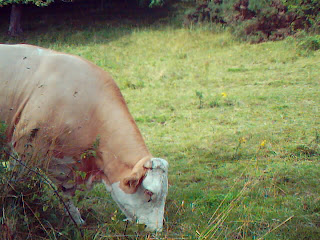
The Culross Coo's
Bob Wallace, (BCIB Fife) has just checked his cameras in Culross, Fife and discovered a grand total of 114 pictures had been taken.........!
.........and every one of them of a bunch of cows. Someone up there is playing tricks on us I think.
Still, I think these beasts are much better looking than Mark Fraser's cows. Maybe a new organisation should be started with both Bob and Mark as founder members.
"Big Coo's In Britain"


.........and every one of them of a bunch of cows. Someone up there is playing tricks on us I think.
Still, I think these beasts are much better looking than Mark Fraser's cows. Maybe a new organisation should be started with both Bob and Mark as founder members.
"Big Coo's In Britain"


Monday, 30 August 2010
Muntjac carcass investigated by a fox and other muntjac
These are the latest shots from the location in Warwickshire where we placed the muntjac roadkill carcass. Lots of pictures of foxes and a couple of nice male Muntjac shots.
Interestingly the dead Muntjac has been moved between the picture of me setting it up, and the next fox picture, without tripping the camera.
Strangely, no animal seems to have tried eating this free meal.
Tim Jenkins
BCIB Warwickshire
Interestingly the dead Muntjac has been moved between the picture of me setting it up, and the next fox picture, without tripping the camera.
Strangely, no animal seems to have tried eating this free meal.
Tim Jenkins
BCIB Warwickshire
Thursday, 26 August 2010
Extraordinary image of a bat in flight
Yet again, the Argyll location throws up another wonderful image. The camera was obviously set off by the young roe deer, but as it flashed, the bat was caught in flight. I'm unsure of the species in question as the image isn't clear. But if anyone has any thoughts we'd love to hear them.
So we can now add "bat" to our ever increasing collection of animals caught on camera
Shaun Stevens
BCIB Argyllshire

Latest:
The owners of the land the photo was taken on, have informed me they have a colony of pipistrelle bats in the roof of their house. There is a good chance this bat is from that colony.
So we can now add "bat" to our ever increasing collection of animals caught on camera
Shaun Stevens
BCIB Argyllshire

Latest:
The owners of the land the photo was taken on, have informed me they have a colony of pipistrelle bats in the roof of their house. There is a good chance this bat is from that colony.
Tuesday, 24 August 2010
Muntjacs from Warwickshire
This weekend I checked my camera in a location in Warwickshire. The only animals captured were muntjac deer. Mainly butt and back shots. The camera was really low down but I think they were walking along a trail right in front of it so I was just getting the tops of their backs. If they had had their heads up even, there would have been some nice shots. When I was stood in front of the cam it was well below my knees in fact I had to get on the ground to swap sd cards
Also I saw a Muntjac roadkill yesterday so we went and picked this up on the way - very fresh and now in front of my cam! Fingers crossed that a big cat sniffs it out.
And yes I know the date is wrong before someone points it out.
Tim Jenkins
BCIB Warwickshire


Also I saw a Muntjac roadkill yesterday so we went and picked this up on the way - very fresh and now in front of my cam! Fingers crossed that a big cat sniffs it out.
And yes I know the date is wrong before someone points it out.
Tim Jenkins
BCIB Warwickshire


Sunday, 22 August 2010
A menagerie of animals from Buckinghamshire
Paul Nicolaides has sent these great pictures from Buckinghamshire. Roe Deer, Muntjac, Foxes, Badgers and even a Grey Squirrel. It can only be time before Paul gets one of a big cat


.
Friday, 20 August 2010
Even the little critters are strutting their stuff now
How does the saying go? Never how far away from a rat?
10 feet, 20 feet, I can't remember who said it and where, but I thought I'd give this little blighter his five minutes of fame, seeing as it keeps cropping up on the trailcam.
They too can travel a lot, up to 2 miles. I know this because some naturalist friends live trapped quite a few, put vegetable dye on their backs and let them go. They then found a couple eating food left out a few nights later. They had travelled nigh on 2 miles but then it was winter so I suppose they look around a lot for food then and there was none where they were let go. All in the interests of science of course.........
Charlie Bones
BCIB Sussex and Sussex Big Cat Watch
10 feet, 20 feet, I can't remember who said it and where, but I thought I'd give this little blighter his five minutes of fame, seeing as it keeps cropping up on the trailcam.
They too can travel a lot, up to 2 miles. I know this because some naturalist friends live trapped quite a few, put vegetable dye on their backs and let them go. They then found a couple eating food left out a few nights later. They had travelled nigh on 2 miles but then it was winter so I suppose they look around a lot for food then and there was none where they were let go. All in the interests of science of course.........
Charlie Bones
BCIB Sussex and Sussex Big Cat Watch
Tree climbing fox, and those pesky fleas
Now that the trailcam is set on video I'll try and post anything of interest. The quality is not as good as stills, as it's not really designed for it, but it does show animal movements and personally I prefer it. There is also a better chance of capturing a bigcat on the video setting.....
Charlie Bones
BCIB Sussex and Sussex Big Cat Watch
Charlie Bones
BCIB Sussex and Sussex Big Cat Watch
Thursday, 19 August 2010
More Roe Deer from Argyll
This is the latest batch of video's of the Roe deer group in Argyll. With appearances from both bucks, several of the does and a little cameo from the twin fawns.
Tuesday, 17 August 2010
"Upon a hill there was a coo..."........or two..or three.
Our esteemed leader Mark Fraser, founder of the BCIB, and all round decent bloke, (I'll expect a cheque in the post now), has a camera in place near to the town of Galston, Ayshire. A location that has a rich history of sightings. There were high hopes for this area until someone let the cows out. As you can see, not everything goes to plan in the search for Big Cats.
As a variation on the old scottish poem goes,


As a variation on the old scottish poem goes,
"Upon a hill, there was a coo, and just to prove it we took a foty too"


Monday, 16 August 2010
We'd like to thank Deben Group Industries for donating a brand new trigger camera.
Deben Group Industries are the sole UK distributer of the US company Hawke Optics, range of equipment.
Today we recieved a wonderful donation from them, of a "ProStalk Nature 3.0 MegaPixel camera", which is a great addition to our camera numbers. It is a high spec camera, which we are hoping to get get some great images from. A feature that is new to me, is a built in microphone, so we should get some sound with our videos in the future from this unit.
The camera will be initially trialled in a secure location before going into the field at a big cat hotspot.

We will be publishing all photographs from this camera in the coming months, so keep an eye out for them.
We at the BCIB would like to thank Kate Cranmer and Tony Gibson at Deben for arranging this donation.
Today we recieved a wonderful donation from them, of a "ProStalk Nature 3.0 MegaPixel camera", which is a great addition to our camera numbers. It is a high spec camera, which we are hoping to get get some great images from. A feature that is new to me, is a built in microphone, so we should get some sound with our videos in the future from this unit.
The camera will be initially trialled in a secure location before going into the field at a big cat hotspot.

We will be publishing all photographs from this camera in the coming months, so keep an eye out for them.
We at the BCIB would like to thank Kate Cranmer and Tony Gibson at Deben for arranging this donation.
Sunday, 15 August 2010
BCIB Trigger Camera Project featured in the National Press
15th August 2010 - Sunday Post - Page 23

Click on image to zoom in and read the article

Click on image to zoom in and read the article
Monday, 9 August 2010
Has a Big Cat finally been captured on a trail cam in Canada
This image has not come from a member of the BCIB, nor is it from the UK. But if genuine, this animal appears to have been captured on the same sort of camera that we are using here in the UK.
Taken in Ontario, Canada, the animal does look on initial impressions to be a melanistic leopard, although without any scale to measure against, size cannot be confirmed. However a close up of the animal shows a tail with a tapered point, as would be expected on a domestic or feral cat. Leopards or jaguars have a blunt tip to their tails. Also questions should be asked why it has taken so long for the story to break, seeing as it appears to have been taken on the 18th April 2010
I'm sure you will all have your own opinions on the cats identity.
The full story can be found at Big cat caught on camera?


Taken in Ontario, Canada, the animal does look on initial impressions to be a melanistic leopard, although without any scale to measure against, size cannot be confirmed. However a close up of the animal shows a tail with a tapered point, as would be expected on a domestic or feral cat. Leopards or jaguars have a blunt tip to their tails. Also questions should be asked why it has taken so long for the story to break, seeing as it appears to have been taken on the 18th April 2010
I'm sure you will all have your own opinions on the cats identity.
The full story can be found at Big cat caught on camera?


Short-Eared Owl on a Car Cam
Although this is not from a trigger cam, it is the result of yet another tool the BCIB members use in their efforts to capture an image of a big cat.
A lot of big cat sightings are made from people's cars, as the cats run across the road in front of them whilst driving. Obviously there is no chance for anybody to stop their cars and whip out a camera, because by the time they have registered what they have seen, the animal has disappeared from sight.
In order to increase their chances of filming a big cat, many BCIB members have rigged up small camcorders in their cars to film the road ahead, whilst visiting big cat locations. Every week, usually on a Sunday night I do just this. With a Sony DCR-SR32 HD Handycam set on "nightshot plus" mode, mounted on the car dashboard with a clamp, I leave at 11 pm to do a 90 minute circuit of the single track B roads through the forests of south Kintyre. Over the years I've filmed deer, foxes, badgers, feral cats, wildcat hybrids, toads, frogs, rabbits, hares, buzzards and tawny owls using this set up. Mostly I manage to get maybe 10-20 seconds of footage of these animals in the car head lights before they run away. Tonight however was a different story. Tonight I managed to get a lovely piece of footage of a species I have never filmed before, a Short-Eared Owl.
I see owls regularly, all of them tawny owls and usually sat on fence posts. They never stay there for long because as soon as you draw near in the car they fly off. Not tonight though. I'd just stopped the car because a wildcat hybrid has crossed in front of me and disappeared into the grass out of sight. As I moved slowly off, about 30 seconds later I saw an animal at the side of the road. Initially I thought it may be a rabbit or even a kitten, (I'd seen a wildcat hybrid with a kitten a mile or so away a few days ago), but as I got closer I could see it was an owl, and not a tawny owl like I usually see, but what I believed was a short-eared owl, (I'm sure the ornithologists out there will correct me if I am wrong). Certainly a new one for me. Interestingly it allowed me to drive right up to it, to about a couple of yards away. After filming it for a minute or so, and realising that it hadn't left the road and flown off, as owls are prone to do whenever I get close to them, I wondered whether it was injured. I live in a place called Campbeltown in Argyll, and we are lucky to have the Scottish Owl Centre in the town, so my thoughts were, if it was injured I could get it to the experts within 20 minutes. So I got out of the car and slowly approached it. As I crouched down to within a few inches of it, it flew off. Why it didn't move off the road as I approached it in the car I have no idea, but it appeared to be in good health and flew off into the night safe and sound.
I may not have got any footage of the local big cat, but to get within a few inches of a beautiful bird like that, more than makes up for it. All in all a great night.
Shaun Stevens
(BCIB Argyllshire)
A lot of big cat sightings are made from people's cars, as the cats run across the road in front of them whilst driving. Obviously there is no chance for anybody to stop their cars and whip out a camera, because by the time they have registered what they have seen, the animal has disappeared from sight.
In order to increase their chances of filming a big cat, many BCIB members have rigged up small camcorders in their cars to film the road ahead, whilst visiting big cat locations. Every week, usually on a Sunday night I do just this. With a Sony DCR-SR32 HD Handycam set on "nightshot plus" mode, mounted on the car dashboard with a clamp, I leave at 11 pm to do a 90 minute circuit of the single track B roads through the forests of south Kintyre. Over the years I've filmed deer, foxes, badgers, feral cats, wildcat hybrids, toads, frogs, rabbits, hares, buzzards and tawny owls using this set up. Mostly I manage to get maybe 10-20 seconds of footage of these animals in the car head lights before they run away. Tonight however was a different story. Tonight I managed to get a lovely piece of footage of a species I have never filmed before, a Short-Eared Owl.
I see owls regularly, all of them tawny owls and usually sat on fence posts. They never stay there for long because as soon as you draw near in the car they fly off. Not tonight though. I'd just stopped the car because a wildcat hybrid has crossed in front of me and disappeared into the grass out of sight. As I moved slowly off, about 30 seconds later I saw an animal at the side of the road. Initially I thought it may be a rabbit or even a kitten, (I'd seen a wildcat hybrid with a kitten a mile or so away a few days ago), but as I got closer I could see it was an owl, and not a tawny owl like I usually see, but what I believed was a short-eared owl, (I'm sure the ornithologists out there will correct me if I am wrong). Certainly a new one for me. Interestingly it allowed me to drive right up to it, to about a couple of yards away. After filming it for a minute or so, and realising that it hadn't left the road and flown off, as owls are prone to do whenever I get close to them, I wondered whether it was injured. I live in a place called Campbeltown in Argyll, and we are lucky to have the Scottish Owl Centre in the town, so my thoughts were, if it was injured I could get it to the experts within 20 minutes. So I got out of the car and slowly approached it. As I crouched down to within a few inches of it, it flew off. Why it didn't move off the road as I approached it in the car I have no idea, but it appeared to be in good health and flew off into the night safe and sound.
I may not have got any footage of the local big cat, but to get within a few inches of a beautiful bird like that, more than makes up for it. All in all a great night.
Shaun Stevens
(BCIB Argyllshire)
Friday, 6 August 2010
Deer Olympics
It looks like our Roe Deer group from Kintyre have decided to enter the Deer Olympics in 2012. As you can see, their training regime includes doing shuttle runs up and down the hill. Hopefully their training will pay off and they will bring home the gold.
Shaun Stevens
(BCIB Argyllshire)
Shaun Stevens
(BCIB Argyllshire)
Subscribe to:
Posts (Atom)