
One of the downsides of putting out these cameras, is the possibilty of them being stolen. I my self had two stolen a few years ago, and other members of the BCIB have also had cameras stolen in the past. I could say something about the people who take these cameras, but what's the point. The police can't do anything about it and the chances of getting them back are virtually nil. We pay for these cameras out of our own pockets and we can't always replace them straight away, especially in todays financial climate.
Bob Wallace had a camera stolen from a location in Fife in August, and we have just been informed that new BCIB member Gary Ridley has had his camera stolen in Surrey.
Gary is offering a reward for the return of the camera, and his story can be read here
http://www.getsurrey.co.uk/news/s/2081288_theft_hampers_efforts_to_snap_legendary_big_cat
Theft hampers efforts to snap legendary big cat
By Guy Martin
October 29, 2010
A CAMERA positioned to capture the appearance of the legendary Surrey puma has itself disappeared this week.
The £300 device was put up at the Wotton Estate on Saturday (October 23) by the Surrey representative of Big Cats in Britain, but by Wednesday it had gone.
Gary Ridley is offering a cash reward for anyone with information on how it disappeared from the White Down Lane area of Abinger Hammer and which leads to its return.
He was keen to gather photographic evidence of the presence of a big cat in the area after a report of a sighting from a train to the north of Dorking station in September.
A woman passenger on her way to work said she had seen a golden brown animal which “looked like a lioness but not as bulky".
The animal was said to be around two metres long and was seen from around 100m away, from the 7.02am train to London Waterloo.
She reported the animal looked like a skinny lioness or a puma, and it was said to be skulking low through a field of sheep. Other passengers had apparently not looked up from their newspapers and so they missed it.
The sighting came as no surprise to Mr Ridley, who had his camouflage bark-coloured camera specially imported from the USA to capture such moments.
He had positioned the specialist piece of equipment, which others will struggle to operate without a manual or expert knowledge, on a gatepost.
“It had only been out there for four nights,” he said. “It’s an area where this cat may well move through. This puma may well have come from the Kent area, from Tunbridge Wells.
“We are trying to establish where they are, but we need proof. It’s all hearsay. There have been lots and lots of sightings so we are desperate to get these cameras out there.
“We’re desperate to get this camera back. I’m appealing to people’s good side to help us get it back.”
Anyone with information or with a sighting to report should e-mail garyridley@hotmail.co.uk.
Mr Ridley said there were signs that big cats were out in the area, but proving it has been difficult because they are so elusive and people are sceptical.
“The amount of sightings that there are prove to us that there is a phenomenon going on,” he said.
“The government are not going to want people to know that there are big cats out there because it will lead to fear.
“Rotting carcasses have gone missing and there are a number of pictures, but they are grainy. We just want one picture, but they are so elusive and they are nocturnal.”
Reported sightings of mystery beasts in the area in the past decade have been made near Farnham as well as in Shamley Green, Worplesdon and Tadworth.
Such sightings have given birth to the popular legend of the Surrey puma, and Mr Ridley said his father-in-law had also seen one in Clandon Park.
“They are out there and they are breeding,” he insisted.

Friday, 29 October 2010


Thursday, 21 October 2010
Little Critters from Warwickshire
Tim Jenkins, the Warickshire rep for the BCIB, has sent in these latest images from his new Scout Guard camera. Because he was unable to bait these cameras, it seems that the larger animals are keeping away, but he did get some nice shots of the country's smaller animals. Grey Squirrel, Rabbit and the smallest deer in the UK, the Muntjac


Saturday, 16 October 2010
When you don't want cats you get them, but perseverance pays off and we finally get an otter on camera
I am lucky enough to have access to a private wood and river in Kintyre, where the owners allow me to trial out my cameras before putting them out in more remote locations. I am able to try different techniques in a safe location trying to get the best shots possible
For a change, as a favour to the owners, I have been trying to get images of the otters that frequent the river. With sardines, codling, and mackeral as bait, the cameras have been placed on a small "beach" on the river bank, where otter prints have been spotted
So what did I get when I first checked the camera, did I get an otter, nope I got a black cat. Not one of the big ones, but a big feral tom cat that puts in rare appearances in the area

Undaunted, I re-baited the area, and left the camera to do its work. Returning today, I collected the SD card from the camera, and checked the images. And what was the first image on the card, was it the elusive otter. No, just another feral cat. This time a black and white one, which the owners think is the mate of the black one.

Here we go again, I thought, but the rest of the pictures on the card, put a smile on my face. We got the otter. Ok, they are not the greatest shots. No perfect profiles, but definitely otter. Another one to add to the list of animals captured on our cameras
Shaun Stevens (BCIB Argyll)


For a change, as a favour to the owners, I have been trying to get images of the otters that frequent the river. With sardines, codling, and mackeral as bait, the cameras have been placed on a small "beach" on the river bank, where otter prints have been spotted
So what did I get when I first checked the camera, did I get an otter, nope I got a black cat. Not one of the big ones, but a big feral tom cat that puts in rare appearances in the area

Undaunted, I re-baited the area, and left the camera to do its work. Returning today, I collected the SD card from the camera, and checked the images. And what was the first image on the card, was it the elusive otter. No, just another feral cat. This time a black and white one, which the owners think is the mate of the black one.

Here we go again, I thought, but the rest of the pictures on the card, put a smile on my face. We got the otter. Ok, they are not the greatest shots. No perfect profiles, but definitely otter. Another one to add to the list of animals captured on our cameras
Shaun Stevens (BCIB Argyll)


Thursday, 14 October 2010
New BCIB Member shows us his recent camera images.
Gary Ridley has recently joined our ranks and will be covering the county of Surrey. He has had trail cameras out in the field for a while and has sent these great clear shots of a fox and badger that were taken recently on his Cuddeback camera.


Tuesday, 12 October 2010
Buzzards and a Hooded Crow
At the new location in Kintyre, I have two Cuddeback cameras at either end of a grass path through a newly planted wood. The trees are about 4-5 foot high. This location was chosen because some large scat was found here in the past which was very cat like. It has been baited with fresh rabbit, (taken by pest control from the local golf courses), with the hope the cat will return.
Well, the rabbit was stripped bare within days leaving nothing but fur and a couple of leg bones. The culprit was not a big cat unfortunately, but a crow, a hooded crow, and two buzzards.
Shaun Stevens
BCIB Argyll


Well, the rabbit was stripped bare within days leaving nothing but fur and a couple of leg bones. The culprit was not a big cat unfortunately, but a crow, a hooded crow, and two buzzards.
Shaun Stevens
BCIB Argyll


Wednesday, 6 October 2010
First pictures from a new location in Kintyre
Although I have left a single camera located at each of the sites in Kintyre previously featured in this blog, I have recently put 6 cameras into a brand new location. This location is one I have been wanting to get into for several years and is smack in the middle of the area that has had more cat sightings than any other in Kintyre over the last 5 years.
These images are from the camera that I currentlty have on loan from a good friend, Dick Raynor of the Loch Ness Investigation Bureau.
I have placed this camera on the edge of a forest fence, where it is obvious that an animal has crawled under it creating a very large hole. As you can see, it is not just one animal that is using this "tunnel", as we have images of both fox and badger. Along with a number of sub-adult pheasants. The hole in the fence is to the left of the frame.


These images are from the camera that I currentlty have on loan from a good friend, Dick Raynor of the Loch Ness Investigation Bureau.
I have placed this camera on the edge of a forest fence, where it is obvious that an animal has crawled under it creating a very large hole. As you can see, it is not just one animal that is using this "tunnel", as we have images of both fox and badger. Along with a number of sub-adult pheasants. The hole in the fence is to the left of the frame.


Saturday, 2 October 2010
Can you identify this animal?
We recieved this from Paul Nicolaides taken at a location in the Chilterns. It possibly could be a Wild Boar. What do you think?


Friday, 1 October 2010
Daytime Shots of a Fox and Wood Pigeon
Most of my images of foxes from Kintyre are usually night shots. But for a change, I managed to get a day time shot of a fox. And just to keep it company I've added a one of a wood pigeon as well
With me being away for a week or so, I'm are slightly behind with the postings on this blog. I have a number of images to put up, and I'll try to do so over the next few days.
Shaun Stevens
(BCIB Argyll)


With me being away for a week or so, I'm are slightly behind with the postings on this blog. I have a number of images to put up, and I'll try to do so over the next few days.
Shaun Stevens
(BCIB Argyll)


More Donated Cameras to add to our efforts.
We have just recieved two Spypoint IR-A Trail Cameras kindly donated by Spypoint and their UK Distributors Thomas Jacks .
.jpg)
These high quality 6.0 Megapixel cameras will allow us to get some great still pictures and video night shots.
One camera is going straight to a brand new location in the south of Kintyre, Scotland this weekend. The other to Ayrshire before being placed in yet another new location in Scotland.
We would like to thank Spypoint and Thomas Jacks Ltd for these cameras, with a special thank you to Ashley Beard at Thomas Jacks who arranged it all.
Images from these cameras will be posted over the coming weeks and months.
.jpg)
These high quality 6.0 Megapixel cameras will allow us to get some great still pictures and video night shots.
One camera is going straight to a brand new location in the south of Kintyre, Scotland this weekend. The other to Ayrshire before being placed in yet another new location in Scotland.
We would like to thank Spypoint and Thomas Jacks Ltd for these cameras, with a special thank you to Ashley Beard at Thomas Jacks who arranged it all.
Images from these cameras will be posted over the coming weeks and months.
Friday, 24 September 2010
Partridges in Sussex, a new species for the blog
The video is a bit smudged from our friend the badger, and on first glance a friend of mine thought they looked more like a New Zealand Kiwi. Kiwis they are not, or else I'd have every birder in Britain trying to find out where the trailcam is and trying to obtain the most tickable bird ever probably)..... but at least for the BCIB, we can now tick off partridge on our species list.
Charlie Bones (BCIB Sussex)
Charlie Bones (BCIB Sussex)
Wednesday, 15 September 2010
Bornean Clouded Leopard Programme, Leopard Cats and Flat Headed cats
One of joys of creating this blog, and using trigger cameras, is finding out about other organisations using the same methods, to capture images of their local wildlife. One research programme, I have been following from my armchair for the last few years is the Bornean Clouded Leopard Programme.
The Bornean Clouded leopard Programme, is a joint multi-site research collaborative effort between the Sabah Wildlife Department in Borneo and the Wildlife Conservation Research Unit (WildCRU), University of Oxford.
They aim to advance understanding and enhance the conservation of the Sunda clouded leopard and other threatened Bornean wild cats in Sabah. This is being done by short term camera trap surveys designed to estimate clouded leopard densities and felid community structure in six key forest areas within Sabah, Borneo. In addition, an intensive camera trap survey is being implemented for approximately 2.5 years at a single forest site, designed to provide insights into the ecology of the clouded leopard.
The project is being led by Andrew Hearn and Joanna Ross.
The Bornean Clouded leopard Programme, is a joint multi-site research collaborative effort between the Sabah Wildlife Department in Borneo and the Wildlife Conservation Research Unit (WildCRU), University of Oxford.
They aim to advance understanding and enhance the conservation of the Sunda clouded leopard and other threatened Bornean wild cats in Sabah. This is being done by short term camera trap surveys designed to estimate clouded leopard densities and felid community structure in six key forest areas within Sabah, Borneo. In addition, an intensive camera trap survey is being implemented for approximately 2.5 years at a single forest site, designed to provide insights into the ecology of the clouded leopard.
The project is being led by Andrew Hearn and Joanna Ross.
Andy and Jo during their last project in Borneo

Andy describes their trail cam methods as such,
We're using several models: Snapshot Snipers (which use a Sony P41/P43 camera), Cuddeback captures, and Bushnell Trophy Cams. We have bait in the past, food items such as shrimp paste etc, as well as trapping lures from the US, but these tended to attract non-target species (bearded pigs and civets mainly), or had no discernible effect on attracting Bornean felids (trapping lures). Having first determined that we could get some of the cats on the cameras we started using mark-recapture methods to estimate their density - and generally it is better not to use bait due to methodological issues.
When available, we place the cameras along existing human trails, the drier, longer and clearer the better. Abandoned old logging roads, again, ideally dry and not too degraded (i.e. still relatively clear of vegetation) are also preferred sites. Natural ridge lines, or other topographical features that may filter animal movements are also used - ridges in particular appeared to selectively utilised by a number of mammals. In the absence of such features, we create our own trails, clearing the vegetation and even sweeping the trail clear of leaf litter. Such trails are typically 4-500 m long, ideally longer, but logistics often mean that this is all we can realistically achieve given our timeframe. Again, many mammals start using the new trails, as can be witnessed by the cameras snapping them moving down the trail.
We typically have a minimum of 35 pairs of cameras running (currently 40 pairs), and we move these to a second survey area, resulting in a survey of a min of 70 sites per 130km2 study area.
Andy and Jo have kindly given us permission to reproduce some of the pictures of cats they have recently captured on camera. There are many more images on their blog site of other animals caputured on camera during their previous research project. It's a blog I would highly recommend to everyone with an interest in wild cats or wildlife in general, it is full of details of the project and its aims. I for one will certainly be following this blog with interest over the following year or so.
All these images are copyright of Andy Hearns and Jo Ross, and should be contacted via their blog if you wish to reproduce these images elsewhere. I have repoduced the comments from the team that accompanies each photograph from their blog.
Our first wild cat photo- capture - a flat-headed cat

A leopard cat. This adaptable species is thought to respond well to habitat disturbance, and unlike the other 4 Bornean felids can be found residing in oil palm plantations. It's a little surprising then, that this is our first photo of this species - but again it is early days.

Our second flat-headed cat photo. Frustratingly, the other camera failed to pick up the cat.

Tuesday, 14 September 2010
More images from the muntjac carcass site.
Tim Jenkins (BCIB Warwickshire), checked his muntjac carcass site yesterday and found some squirrel, deer and fox pictures as well as his first pictures of a badger. When Tim got there the cam had big muddy paw prints over it where the badger had investigated it VERY closely. This is the second badger in less than a week that has had a go at one of our cameras in locations hundreds of miles apart.


Monday, 13 September 2010
Hungry badger taste testing the camera.
I had a bit of a shock when I recently checked the trailcam. I check it every week, the batteries and memory can last at least a month but I look forward to viewing what pictures it's captured, I find it very exciting and captivating. Plus if anything has gone wrong, I can sort it out.
On checking the camera this time I found the camo net was torn and the lens was smudged. Although the angle was still roughly right it certainly wasn't how I left it.
The culprit, as I played back the 30 second film was plain to see. It was the badger who shows up from time to time. Still, no harm done as it seems this cam is bulletproof and hopefully it will leave it alone now it's had a taste. I've set it for the prime purpose of capturing a cat, so even the up close shots should fit the whole body in. Although the videos now will be a bit overexposed as it points more up to the sky......
Charlie Bones (BCIB Sussex)
On checking the camera this time I found the camo net was torn and the lens was smudged. Although the angle was still roughly right it certainly wasn't how I left it.
The culprit, as I played back the 30 second film was plain to see. It was the badger who shows up from time to time. Still, no harm done as it seems this cam is bulletproof and hopefully it will leave it alone now it's had a taste. I've set it for the prime purpose of capturing a cat, so even the up close shots should fit the whole body in. Although the videos now will be a bit overexposed as it points more up to the sky......
Charlie Bones (BCIB Sussex)
Wednesday, 8 September 2010
Badger, Fox and Roe Deer
Here are the latest batch of images from the same location as the unidentified large cat in Argyll. Along with tens of pictures of a fox, there was also one of the badger, that likes to make an appearance every now and then, (and I still can't find out where it is coming from as there is no sign of a badger sett anywhere nearby). Also a nice close up picture of a roe deer doe, and a blurry roe deer buck on the run
Shaun Stevens (BCIB Argyll


Shaun Stevens (BCIB Argyll


Black Cat and Rabbit
Once again the heart skips a beat when I saw it, but once again it's a black feral cat and it looks similar to the one I posted earlier. There havn't been any foxes show up on the cam since the end of July, but I doubt whether this sort of cat would put them off. Perseverance, hopefully, will pay dividends.
Charlie Bones (BCIB Sussex and Sussex Big Cat Watch)
Charlie Bones (BCIB Sussex and Sussex Big Cat Watch)
Friday, 3 September 2010
The Culross Coo's
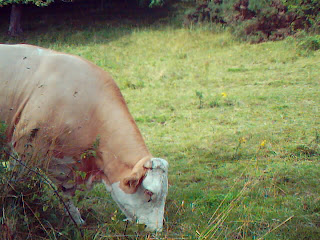
Bob Wallace, (BCIB Fife) has just checked his cameras in Culross, Fife and discovered a grand total of 114 pictures had been taken.........!
.........and every one of them of a bunch of cows. Someone up there is playing tricks on us I think.
Still, I think these beasts are much better looking than Mark Fraser's cows. Maybe a new organisation should be started with both Bob and Mark as founder members.
"Big Coo's In Britain"


.........and every one of them of a bunch of cows. Someone up there is playing tricks on us I think.
Still, I think these beasts are much better looking than Mark Fraser's cows. Maybe a new organisation should be started with both Bob and Mark as founder members.
"Big Coo's In Britain"


Monday, 30 August 2010
Muntjac carcass investigated by a fox and other muntjac
These are the latest shots from the location in Warwickshire where we placed the muntjac roadkill carcass. Lots of pictures of foxes and a couple of nice male Muntjac shots.
Interestingly the dead Muntjac has been moved between the picture of me setting it up, and the next fox picture, without tripping the camera.
Strangely, no animal seems to have tried eating this free meal.
Tim Jenkins
BCIB Warwickshire
Interestingly the dead Muntjac has been moved between the picture of me setting it up, and the next fox picture, without tripping the camera.
Strangely, no animal seems to have tried eating this free meal.
Tim Jenkins
BCIB Warwickshire
Thursday, 26 August 2010
Extraordinary image of a bat in flight
Yet again, the Argyll location throws up another wonderful image. The camera was obviously set off by the young roe deer, but as it flashed, the bat was caught in flight. I'm unsure of the species in question as the image isn't clear. But if anyone has any thoughts we'd love to hear them.
So we can now add "bat" to our ever increasing collection of animals caught on camera
Shaun Stevens
BCIB Argyllshire

Latest:
The owners of the land the photo was taken on, have informed me they have a colony of pipistrelle bats in the roof of their house. There is a good chance this bat is from that colony.
So we can now add "bat" to our ever increasing collection of animals caught on camera
Shaun Stevens
BCIB Argyllshire

Latest:
The owners of the land the photo was taken on, have informed me they have a colony of pipistrelle bats in the roof of their house. There is a good chance this bat is from that colony.
Tuesday, 24 August 2010
Muntjacs from Warwickshire
This weekend I checked my camera in a location in Warwickshire. The only animals captured were muntjac deer. Mainly butt and back shots. The camera was really low down but I think they were walking along a trail right in front of it so I was just getting the tops of their backs. If they had had their heads up even, there would have been some nice shots. When I was stood in front of the cam it was well below my knees in fact I had to get on the ground to swap sd cards
Also I saw a Muntjac roadkill yesterday so we went and picked this up on the way - very fresh and now in front of my cam! Fingers crossed that a big cat sniffs it out.
And yes I know the date is wrong before someone points it out.
Tim Jenkins
BCIB Warwickshire


Also I saw a Muntjac roadkill yesterday so we went and picked this up on the way - very fresh and now in front of my cam! Fingers crossed that a big cat sniffs it out.
And yes I know the date is wrong before someone points it out.
Tim Jenkins
BCIB Warwickshire


Subscribe to:
Posts (Atom)